What does product design got to do with it?
What is a product designer doing at OneSpring®? Okay I admit it – interface design was not my childhood fantasy.

I wanted to design cars. It didn’t matter if they were swoopy sportscars crouched low slithering over the street or burly SUV’s ready to tear up a woodland trail, I just knew I loved drawing new ones to capture peoples’ desire. Growing up near Atlanta my dream school was Georgia Tech. I wore Yellow Jackets swag to school at least once a week starting in fifth grade. When it was finally my turn to study on The Flats I was ready to be transformed into some kind of design wizard powerful enough to conjure up electrifying drawings, models and business cases for the next generation of awe-inspiring “futurecars.” Despite wanting to mesmerize the populace with automotive fireworks, I was lost as to how to realize such feats of enchantment. No problem. I would soon learn all I ever wanted to know about that. After a grueling undergraduate journey through deserts of history and literature, over treacherous peaks of calculus, chemistry and physics and through complex, endless swamps of design studios I emerged on the other side with plenty of new knowledge. All of it, however, served one new possession of singular importance – a process I believed in.
I know, I know – a process? Maybe it’s not glamorous, but stay with me. The kid who had wanted to brighten the eyes of millions with sweeping curves and tire smoke had mistakenly wanted to go it alone. I wanted to be the idea guy, the design guy, and the business guy…and all the guys who work for them! Since that naïve time I had become familiar with what it took to actually achieve in three “pick me up and use me” dimensions any sort of designed artifact. I’m here to tell you the first thing it takes is other people. What about the other people? Well, the minds of those other people – the same people a designer needs if he is to achieve his vision – cannot be utilized unless communication is clear. And if we want people’s minds working at maximum capacity, we need to maximize the communication. More on that later. Is that a question I see there in the back?
Where does OneSpring® come in, you ask? Well, as it turns out, I was looking for a job. Yes, those are the sad ramen-eating college senior violins you’re hearing. As I was looking around, I got an email from my academic advisor about a new Atlanta company doing something foreign to me called “user experience design.” Well, not a car company, but I was not too proud to inquire. A week’s passing had me sitting at coffee with a hip young professional this company had dubbed a “Visualization Designer.” That person explained to me a thing of singular importance driving OneSpring® – a process. It wasn’t just any process to them. It was their process, and they all believed in it. You’re seeing parallels, no? Well, I certainly noticed them. Turns out the same things it takes to realize designs in the product space are relevant to software design projects. How so? Well, read on.
Remember I told you there’d be more to come regarding the issue of communication? Here it is. Communication is the reason for this process. What I learned in school is a lesson inextricably baked into the methods employed at OneSpring®. Namely, that we cannot clearly communicate an idea or a concept to a broad range of people unless those people can see and interact with it. For a student of industrial design like I had been, it meant never presenting a new product concept by words alone. Teams of stakeholders needed sketches, renderings, models, prototypes – each more and more like the final implementation as the projects progressed. And when time came to pitch the concept to a jury of clients, there was nothing like a beautiful working prototype to cement ideas. In fact, it was this process of “show me, don’t just tell me” that I had fallen in love with in college.
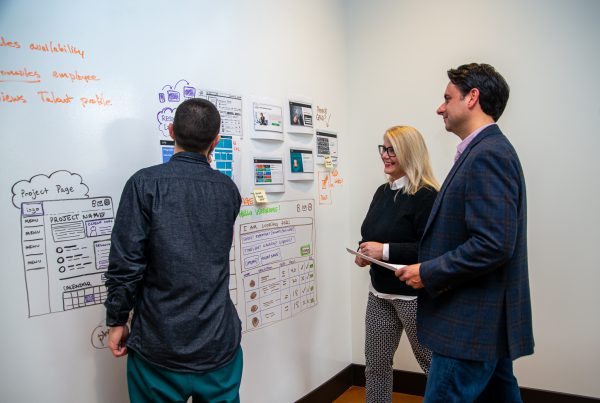
Coincidentally OneSpring’s field of requirements definition relies on the exact same idea. Your team, whoever you are and whichever type of project you’re undertaking, is not capable of being “on the same page” until the project’s vision is expressed in a visual, interactive format. Your stakeholders, be they users, clients, developers, manufacturers, analysts, or designers cannot fully share a unified vision of your project unless it is present in the room with them able to be passed around and discussed openly. They must see it and interact with it together and share their thoughts. Only in this way can teams write authoritative requirements and developers build accurate systems which need no rework. OneSpring® calls it “visualization.” Now, as a “Visualization Designer” for OneSpring®, I call it common sense.
The Requirements Agency